
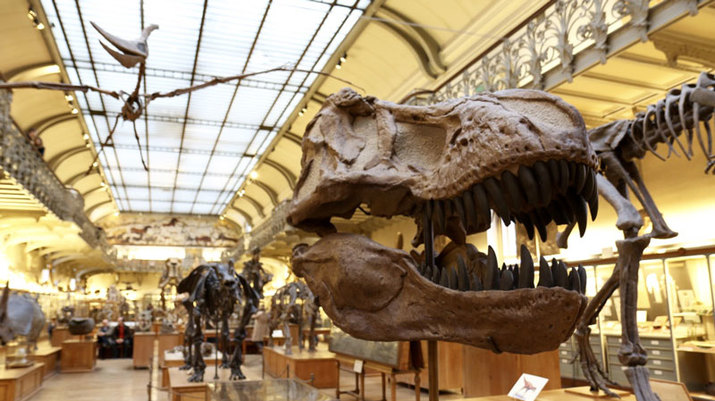
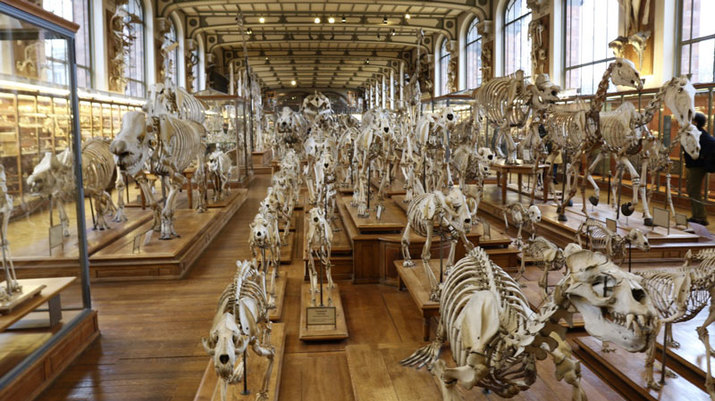
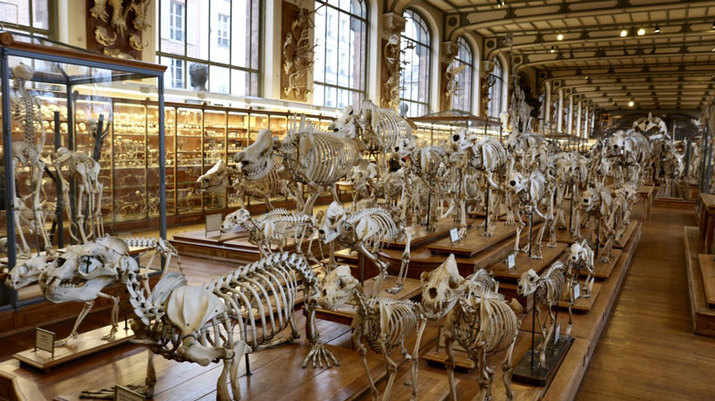
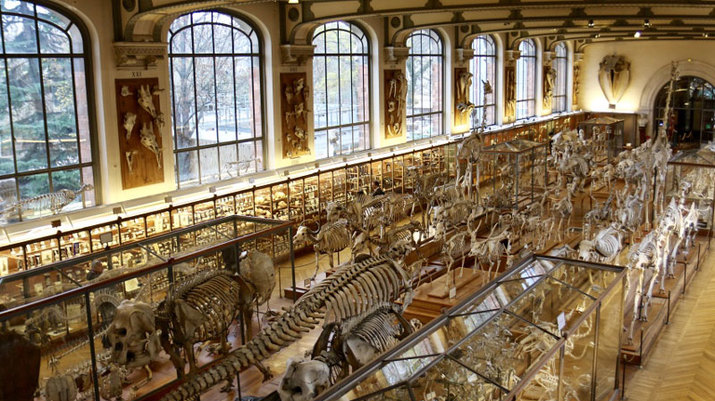
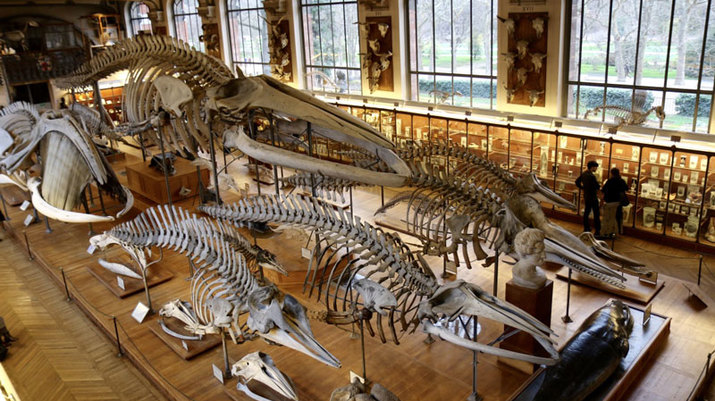
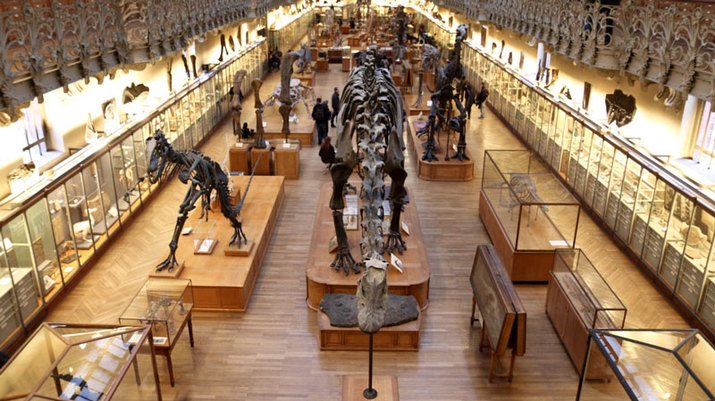
The National Museum of Natural History in Paris is one of the oldest institutions dedicated to science, not only in France but in the entire world. It was formally established on June 10, 1793, during the French Revolution. But in reality, its origins go back to the "Royal Garden of Medicinal Plants," one of the oldest scientific institutions in France, founded in 1635 during the reign of Louis XIII. The Museum comprises several different departments: the Jardin des Plantes, the Museum of Mankind, the Great Gallery of Evolution, the Gallery of Mineralogy and Geology, the Gallery of Paleontology and Comparative Anatomy, and the Ménagerie of the Jardin des Plantes.
Highlights
The dinosaur floor
In the Gallery of Paleontology and Comparative Anatomy, you'll find a wide range of skeletons and fossils of vertebrate animals. On the second floor of the building specifically, you'll find the dinosaur skeletons, which are without question the most impressive attraction given the sheer size and mystery of these prehistoric creatures.

The Jardin des Plantes
This is a vast botanical garden, the largest in all of France. It features numerous greenhouses filled with exotic plants, an alpine garden with more than 2,000 species of mountain plants, a rose garden, a labyrinth built in the 18th century, and even the world's oldest zoo, a favorite among the youngest visitors.
The Great Mosque of Paris
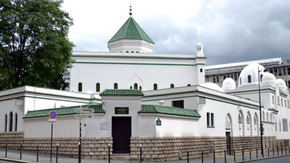
This is the largest mosque in all of France and the second largest in Europe. It was built in 1926 by President Gaston Doumergue, after the First World War, to honor the memory of Muslims who died in combat. It stands in the Latin Quarter, just a short walk from the Museum of Natural History, and is notable for its distinctive style inspired by the mosque of Fez (Morocco).
Infos pratiques
Tips
A reduced rate is available for large families. In addition, admission to the National Museum of Natural History in Paris is free if you have a disability and are accompanied by a carer, if you're under 26, a member of ICOM, a journalist, a job seeker, a recipient of social welfare benefits, or a working primary or secondary school teacher.
How to get there
To reach the Museum, take metro line M5 to the "Gare d'Austerlitz" station. You can also take lines M7 or M10 to the "Jussieu" station. It's also possible to take the RER C to Paris Austerlitz station and then enter via Rue Buffon. Finally, buses 24, 57, 61, 63, 67, 89, and 91 all stop at "Mosquée / Jardin des Plantes."
Opening hours
Nearby

Comments
No comments yet.