The emergency numbers to know
- 15 — SAMU: medical emergency (feeling unwell, serious injury, need for an ambulance). Free, available 24 hours a day.
- 17 — Police: security emergency (assault, violent theft, accident requiring police intervention). Free, 24 hours a day.
- 18 — Fire brigade: fire, but also rescue and first medical aid in many cases (the Paris fire brigade very often responds to medical emergencies, alongside or instead of the SAMU depending on availability). Free, 24 hours a day.
- 112 — European emergency number: a single number valid throughout the European Union, useful if you do not know which of the previous numbers to choose or if you are more comfortable with a "generic" number. Free, 24 hours a day, reachable even with no credit on a mobile phone.
- 114 — Emergency by text/video call for people who are deaf, hard of hearing or have a speech impairment: a dedicated free emergency number, reachable by text or video call (sign language), 24 hours a day, to contact the police, fire brigade or SAMU without a conventional voice call.
In practice, for an immediate medical emergency, the simplest reflex remains dialling 15 or 112: the switchboards are generally able to direct a non-French-speaking caller or switch to a suitable operator.
Finding a duty pharmacy (night, Sunday, public holiday)
Paris pharmacies generally close in the evening and on Sundays, but a duty rota ensures continuous cover: at any time, at least one pharmacy stays open or reachable in each sector. To find it:
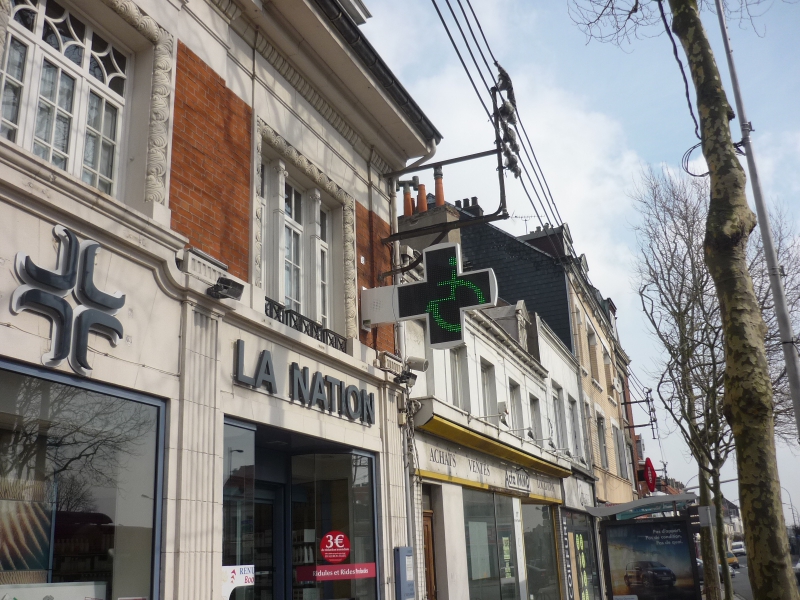
- The simplest and free: the window of every closed pharmacy displays, by legal obligation, the address of the nearest duty pharmacy, often on an illuminated sign visible at night.
- Online, free: dedicated online services (search by town or postcode) let you instantly locate the nearest duty pharmacy, at no charge.
- By phone, paid service: the number 3237 puts you in touch with a duty pharmacy, charged at the rate stated by the operator (generally around €0.35/minute plus the cost of the call depending on your plan) — to be kept for cases where an online search is not possible.
- In an emergency at night: night-duty pharmacies are often closed "behind shutters" for security reasons and only open after verification, sometimes via the nearest police station, which can confirm the emergency with the pharmacist. Have an ID document, your health/travel insurance card and, if needed, a prescription to hand.
Getting treatment when it is not life-threatening
For a health problem that is not an emergency (a stubborn cold, a minor injury, the need for a prescription), several options exist outside hospital emergency departments, which should be kept for serious cases:
- A general practitioner in a surgery, by appointment or sometimes as a walk-in depending on the practice.
- A maison médicale de garde (out-of-hours medical centre), which provides consultations without an appointment in the evening, at weekends and on public holidays, to make up for surgeries closed at those times.
- A pharmacy, whose team can point you towards the most suitable solution and dispense certain medicines without a prescription for minor symptoms.
Insurance and coverage for foreign visitors
The French healthcare system generally applies payment for care at the time of the consultation, with subsequent reimbursement according to each person's cover. Visitors from the European Union can benefit from partial coverage with their European Health Insurance Card; visitors from outside the EU will most often have to pay upfront and then be reimbursed by their travel insurance. It is recommended to take out travel insurance covering medical costs before departure, particularly for visitors from outside the European Union, and to keep all supporting documents (invoices, prescriptions) with a view to reimbursement.
For your everyday safety in Paris, see also our guides to safety in Paris at night and scams to avoid in Paris.