Opened in 1804, Père-Lachaise was the first Paris cemetery designed as a garden rather than a simple burial enclosure: architect Alexandre-Théodore Brongniart laid out winding, English-style paths, planted with a variety of trees, that follow the slope of a hill in the 20th arrondissement. Beyond the famous graves that built its reputation, it's this dimension as an open-air garden-museum, with 44 hectares of 19th-century funerary sculpture and architecture, that rewards a proper visit rather than a quick pass-through.
Getting your bearings at the entrance
The cemetery has five entrances and 97 numbered divisions, and a free map is available at each one. Pick one up as soon as you arrive: without it, it's easy to lose your way in the network of paths, even on a short visit.
The main gate and chapel
From boulevard de Ménilmontant, the neoclassical gate designed by Étienne-Hippolyte Godde, inaugurated in 1825, sets the architectural tone for the visit. The cemetery's Catholic chapel, also by Godde, stands a short walk away and makes a useful central landmark for exploring the surrounding divisions.
The oldest divisions
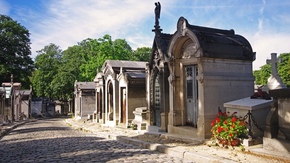
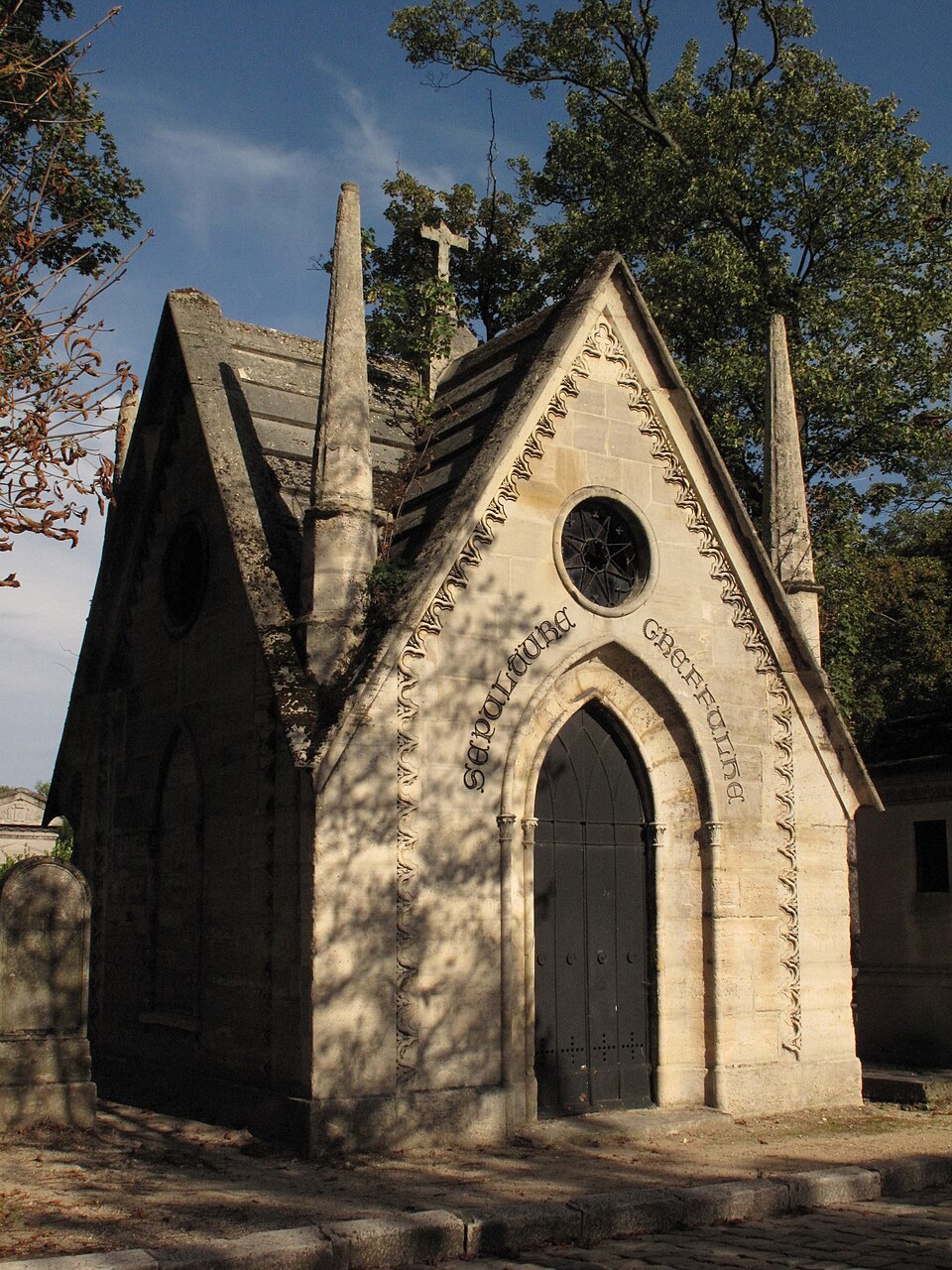
The divisions nearest the main entrance are among the cemetery's oldest and hold a dense concentration of 19th-century funerary sculpture: miniature chapels, stone angels and Art Nouveau mausoleums line the paths one after another, no need to hunt for a specific grave to appreciate the walk.
The Mur des Fédérés
In the southeastern part of the cemetery, this wall is where the last 147 fighters of the Paris Commune were executed in May 1871. The site remains a memorial landmark for the French left, with an annual commemoration held there, giving the visit a historical dimension beyond the stroll itself.
The crematorium-columbarium
Built from 1894 by architect Jean Camille Formigé in a neo-Byzantine style, this domed building holds more than 26,000 niches spread across five levels. It's one of the cemetery's most striking architectural ensembles, largely away from the busiest paths.
Finding a specific grave without getting lost
The map available at the entrances lists more than a hundred famous graves with their exact location by division number. Rather than searching at random, bring this map or a dedicated app if a particular name interests you: the grounds are too vast to improvise effectively.
Tips
Allow at least two hours for a visit that goes beyond a simple crossing, more if you linger in the oldest divisions. The ground is hilly and paved in places, so wear shoes suited to extended walking. Hours vary by season and day of the week (generally 8am-6pm on weekdays, a slightly later opening on weekends), and the cemetery closes its gates before nightfall year-round. A late-morning visit, when crowds are still moderate, leaves time to enjoy the quiet of the paths before the afternoon's guided groups arrive.